Onchain Product · 2024–Present · Live
Checks Wiki
Tools for collectors, before a merge they can’t undo.
Checks is an art collection where merging two tokens burns one for good, and collectors had little to go on before a merge they can’t undo. Checks Wiki is a collection of tools I designed and built for collectors, held to one rule, show the outcome before the irreversible step: price a single check two ways, preview every composite a set can make, and pool ETH toward a Black Check. All three are live with three contracts on Ethereum, and Jack Butcher, the artist behind Checks, quoted the launch. I’m still building, to give more collectors a reason to use it.
- Role
- Solo: design and build
- Year
- 2024–Present
- Chain
- Ethereum
- Status
- Live
- Live
- Visit live ↗
Problem
A merge can't be undone, and collectors had little to go on before one: no way to compare buying a single check with composing it, no preview beyond two checks they already owned, and nothing built around the Black Check.
Approach
Three connected tools on checks.wiki: price it, preview it, pool it.
Result
All three tools are live, with three contracts on Ethereum behind them, and Jack Butcher, the artist behind Checks, quoted the launch.
Design principles
Answer before analysis
The verdict comes first, then the working.
Preview before an irreversible action
Every composite is shown before anything is burned.
Make trust inspectable
The page shows the exact check a pool will produce, and the rules it is held under, before anyone deposits.
01 · Context
The end goal is a Black Check.
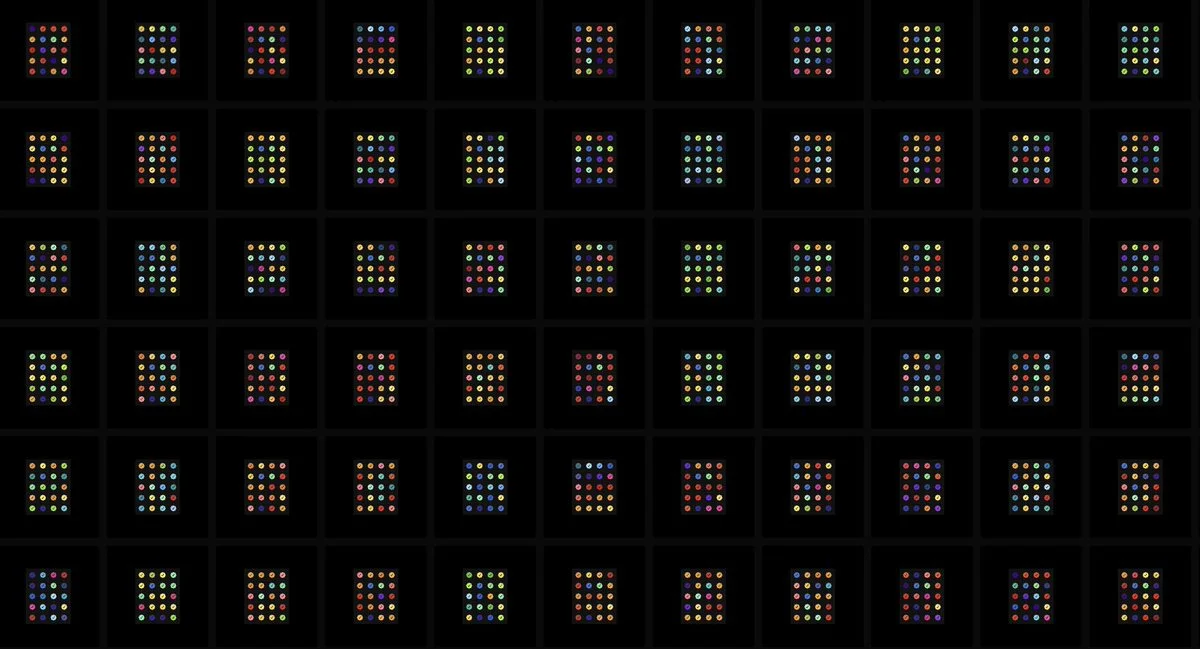
It takes 64 single checks to make a Black Check. Only three can ever exist.
Checks is easiest to explain backwards. The rarest piece in the collection is a Black Check, and it takes 64 single checks to make one. A single check takes 64 tokens: merge two, and one survives with half as many checks while the other is burned for good. That is 4,096 checks in and one out.
02 · Context: Origin
It started with one question.
Is it cheaper to buy a single check, or to buy 64 tokens and compose one?
- Views
- 6,709
- Likes
- 41
- Reposts
- 7
- Quotes
- 3
- Replies
- 5
 Harsh@0xHarsheth · Jul 22, 2024GM 👋 I've developed a tool that helps you find the most cost-effective way to get a single check by analyzing the Checks market.
Check it out and let me know what you think
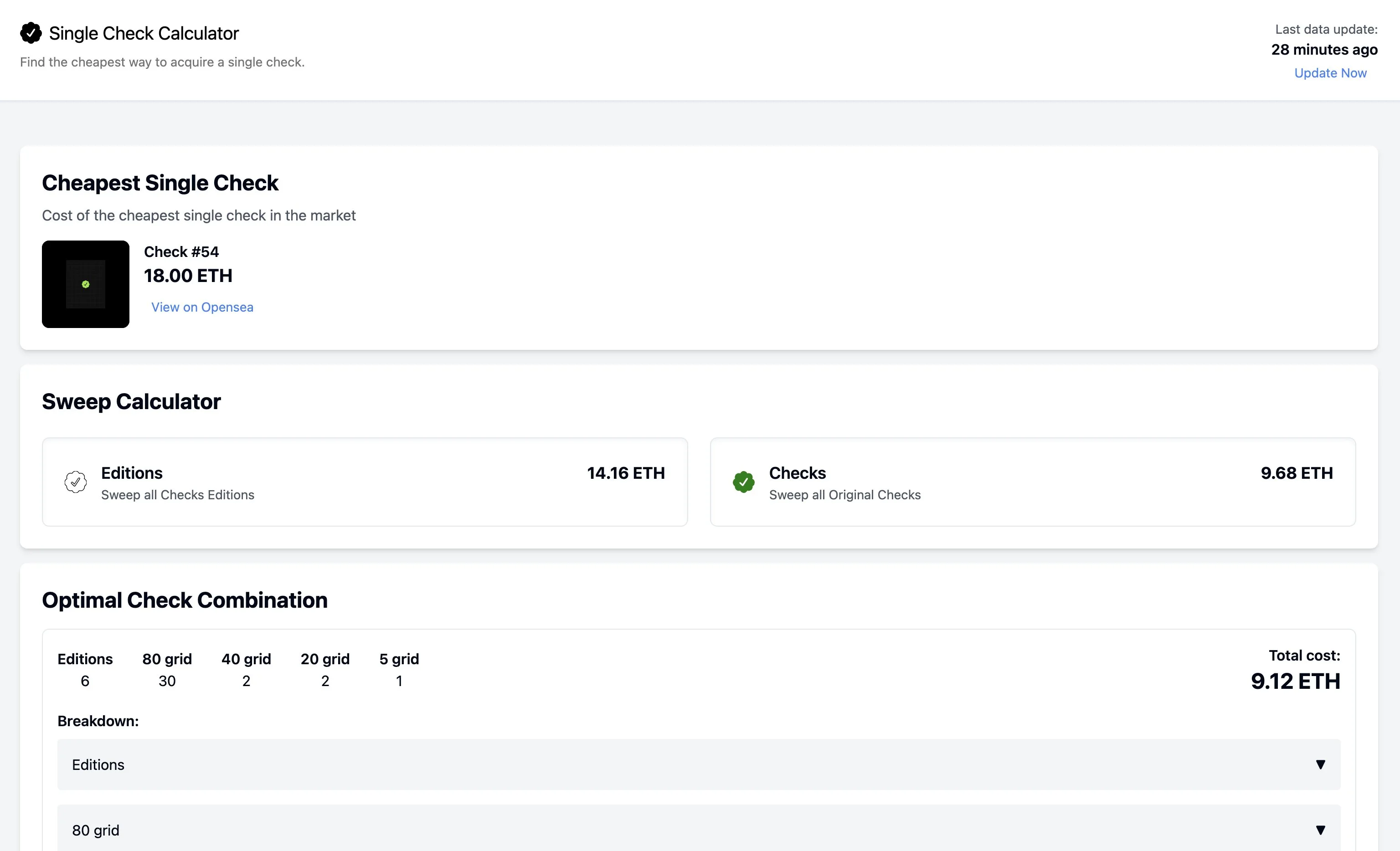
That was the one thing I wanted to know in 2024. I built a calculator that read the market and worked out the real cost of each route. I later shut that site off and rebuilt it as the first tool on Checks Wiki.
03 · Problem
Three things collectors couldn't see.
Nobody knows what a merge will produce until it has happened.
People buying a single check don't look at what composing one would cost. The Checks site previews one pair at a time, and only checks you already own. And the Black Check is a very long-term goal with barely any infrastructure around it, because most people don't want to give up checks they curated to get there.
04 · Design: Price
The verdict comes first.
Buy or compose, answered in one sentence at the top of the page.
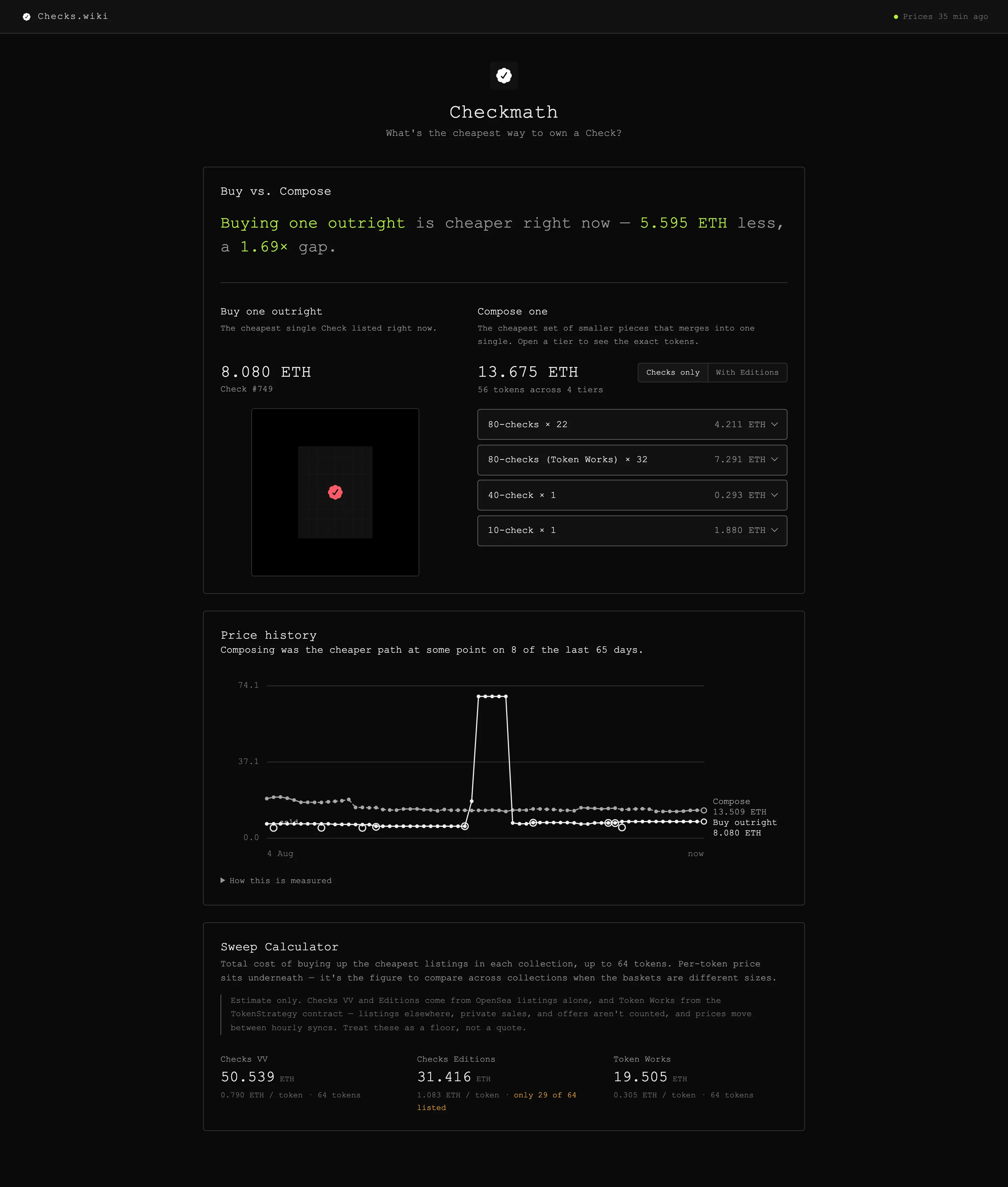
- How fresh it is. The page reprices hourly and says how long ago.
- The verdict, in one sentence. Which route is cheaper right now, and by how much.
- Both routes, side by side. The cheapest single check, and the cheapest set of tokens that composes one.
- History, after the answer. Which route was cheaper over recent weeks, for anyone who wants it.
calc.checks.wiki shows the working beneath the answer: the cheapest single check on the market, and the cheapest set of tokens that composes into one. The answer changes by the hour, so the page recomputes it every hour.
- Chose
- A verdict in plain sentences, at the top
- Instead of
- Leading with charts of the two routes
- Because
- The question has a one-line answer. The price history sits below it for anyone who wants the detail.
05 · Design: Preview
See every composite before you burn.
Every composite a set of checks can make, drawn by a port of the contract's own drawing code.
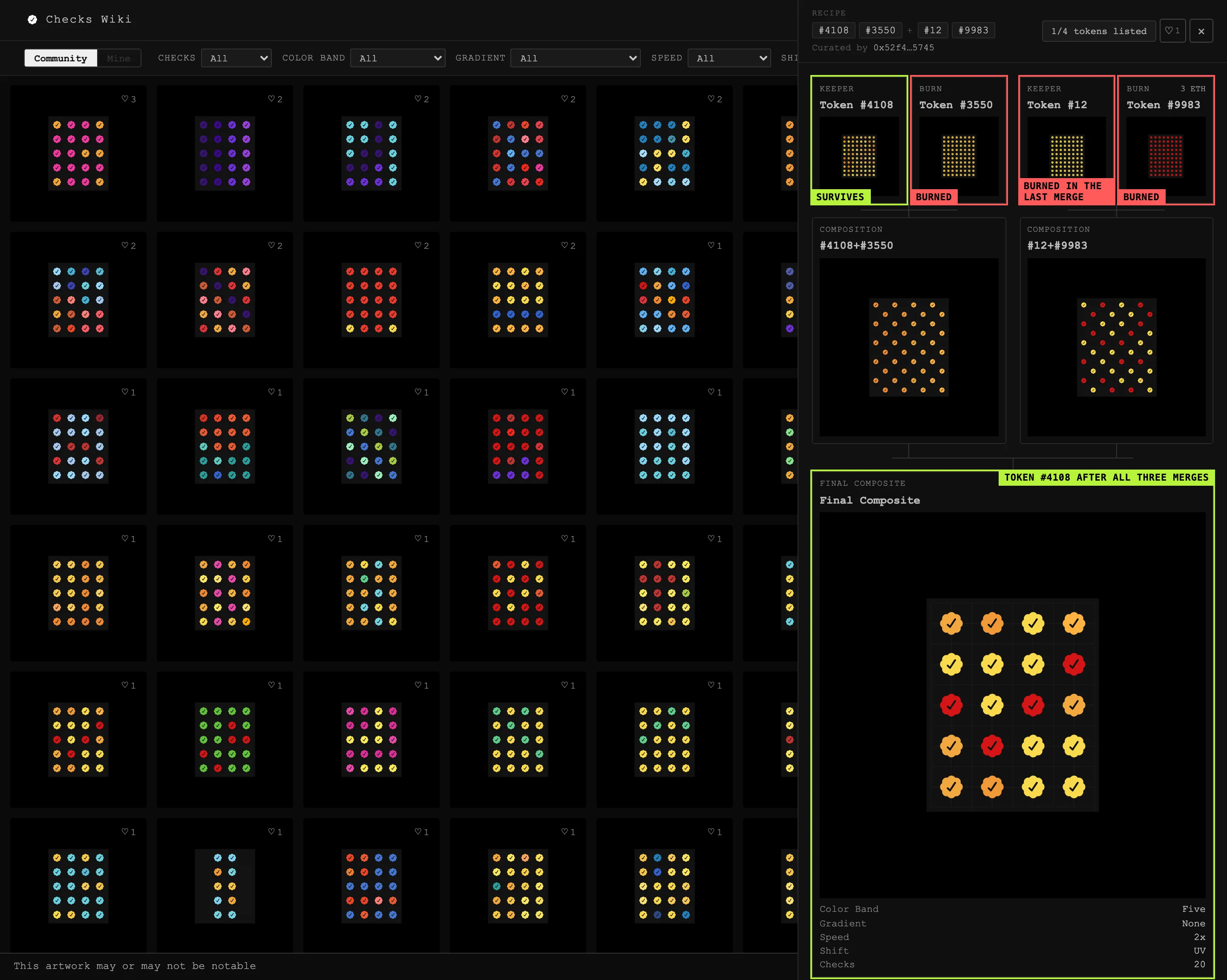
- What is for sale. How many of the recipe’s tokens are listed right now.
- Keeper or burn, before anything happens. Every token in the recipe is labelled with its fate.
- The outcome, not a sketch. Drawn by a port of the contract’s own drawing code.
explore.checks.wiki works on the checks in your wallet, the ones for sale, or any token ids you type in. Because the drawing code is ported from the contract's own, the picture is the outcome and not a sketch of it. And a recipe whose checks are for sale can be bought and merged in one transaction: all four are bought and merged, or nothing happens.
- Chose
- Buy the four checks and merge them in one transaction
- Instead of
- A preview that ends at the picture, with four purchases and three merges left to do by hand
- Because
- The transaction either makes the composite on screen or reverts. Nobody is left holding half a recipe.
06 · Design: Pool
A Black Check nobody has to give up a check for.
Before anyone deposits, the page shows the exact check the pool will produce.
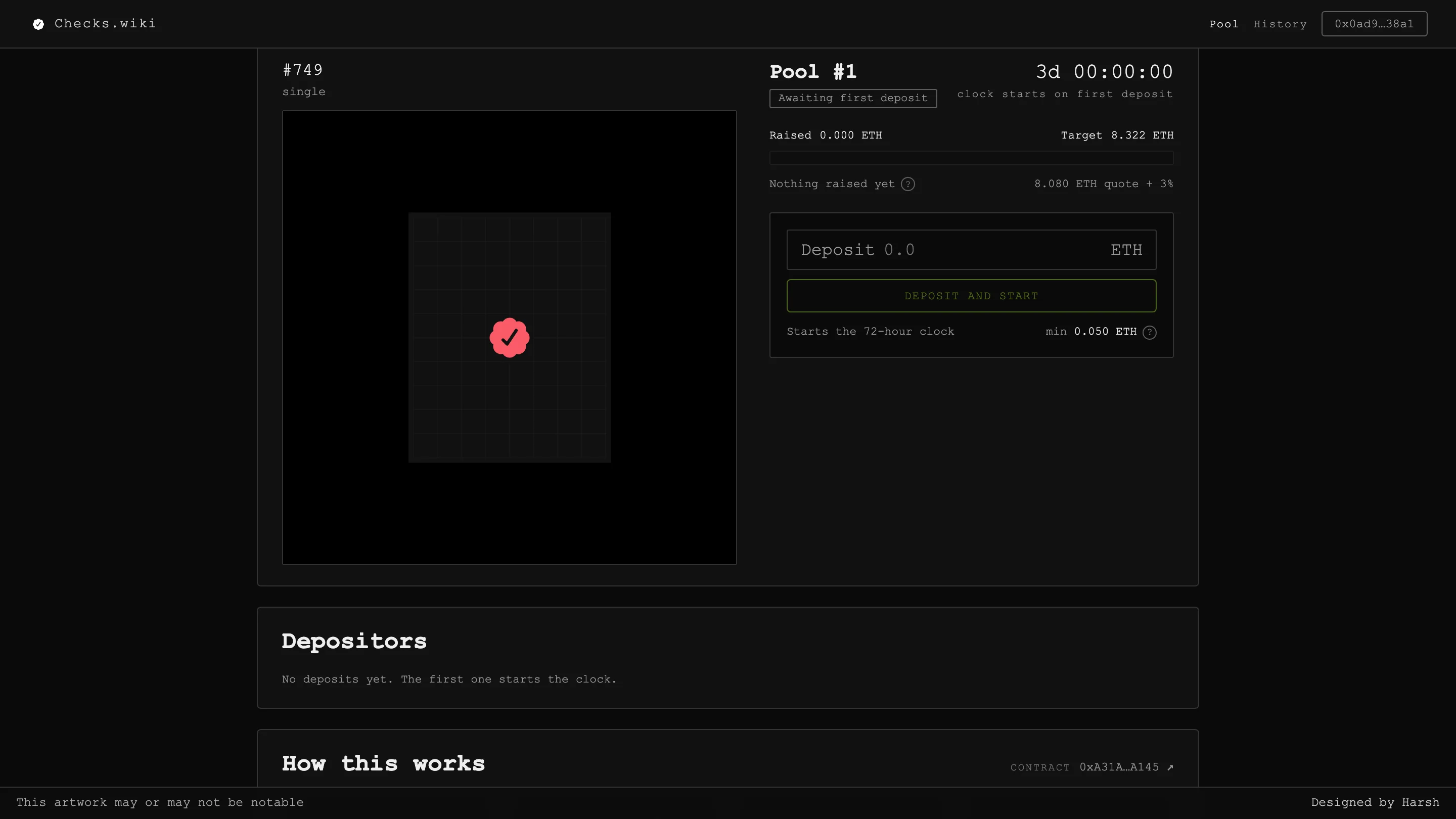
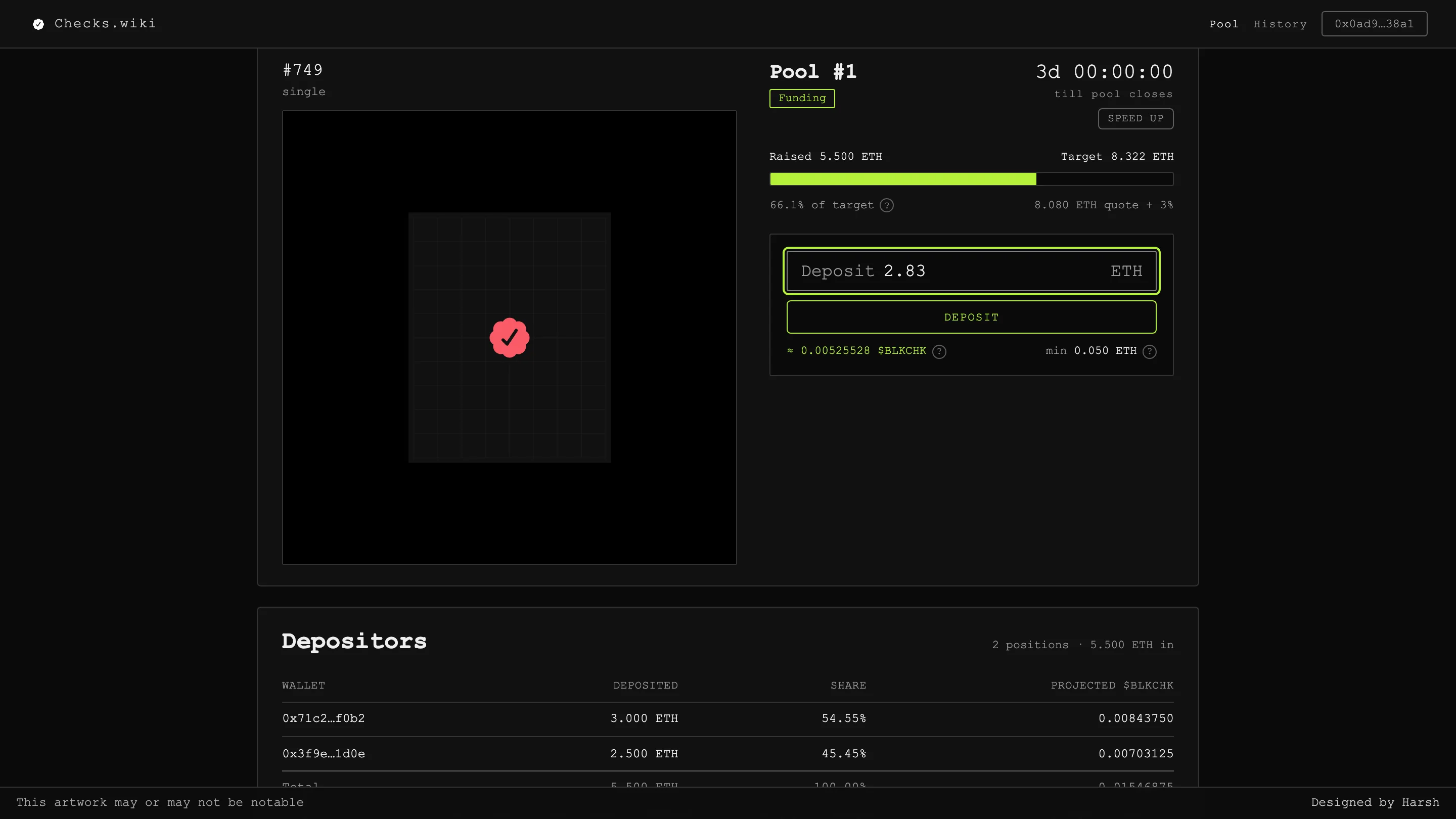
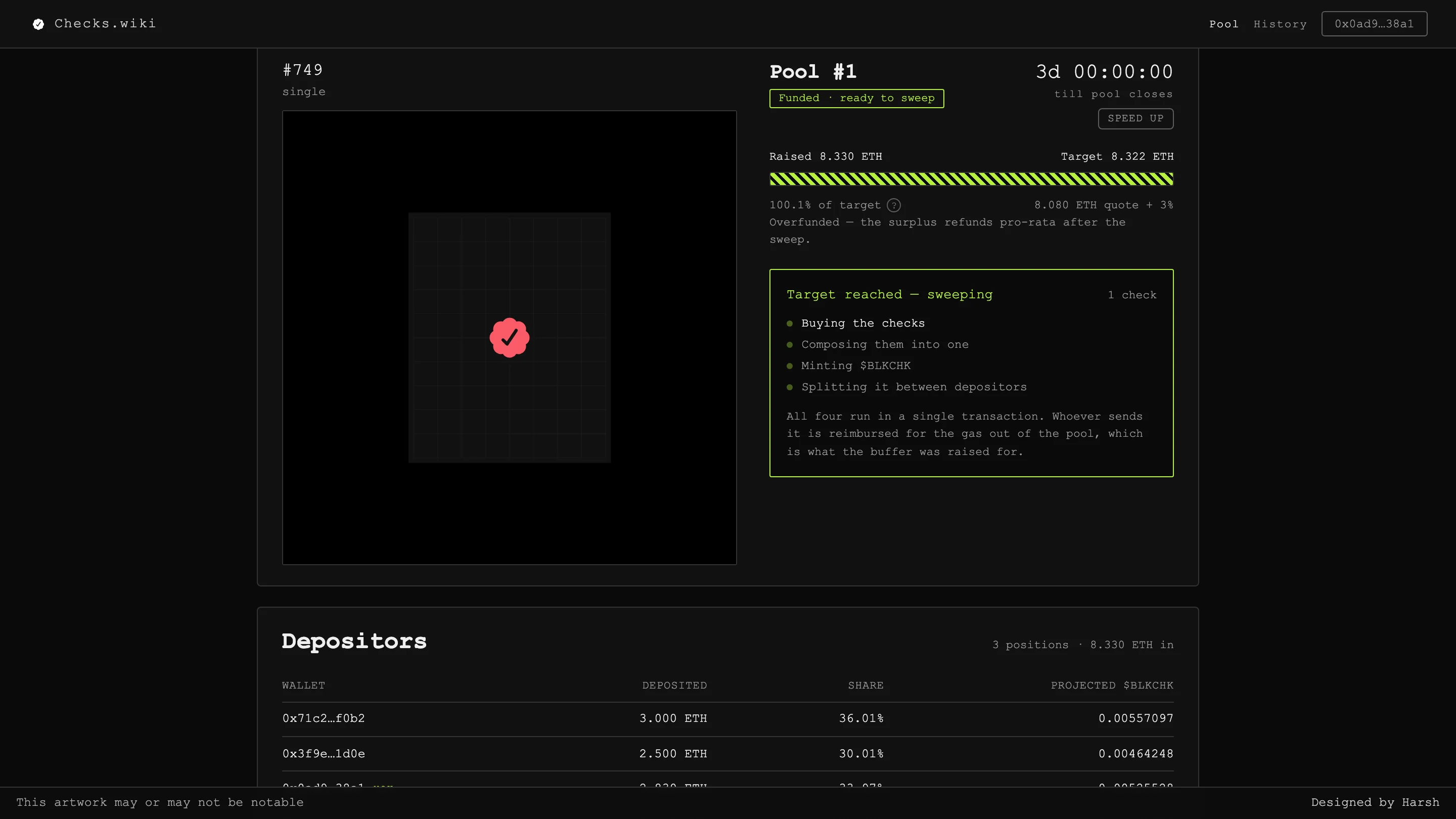
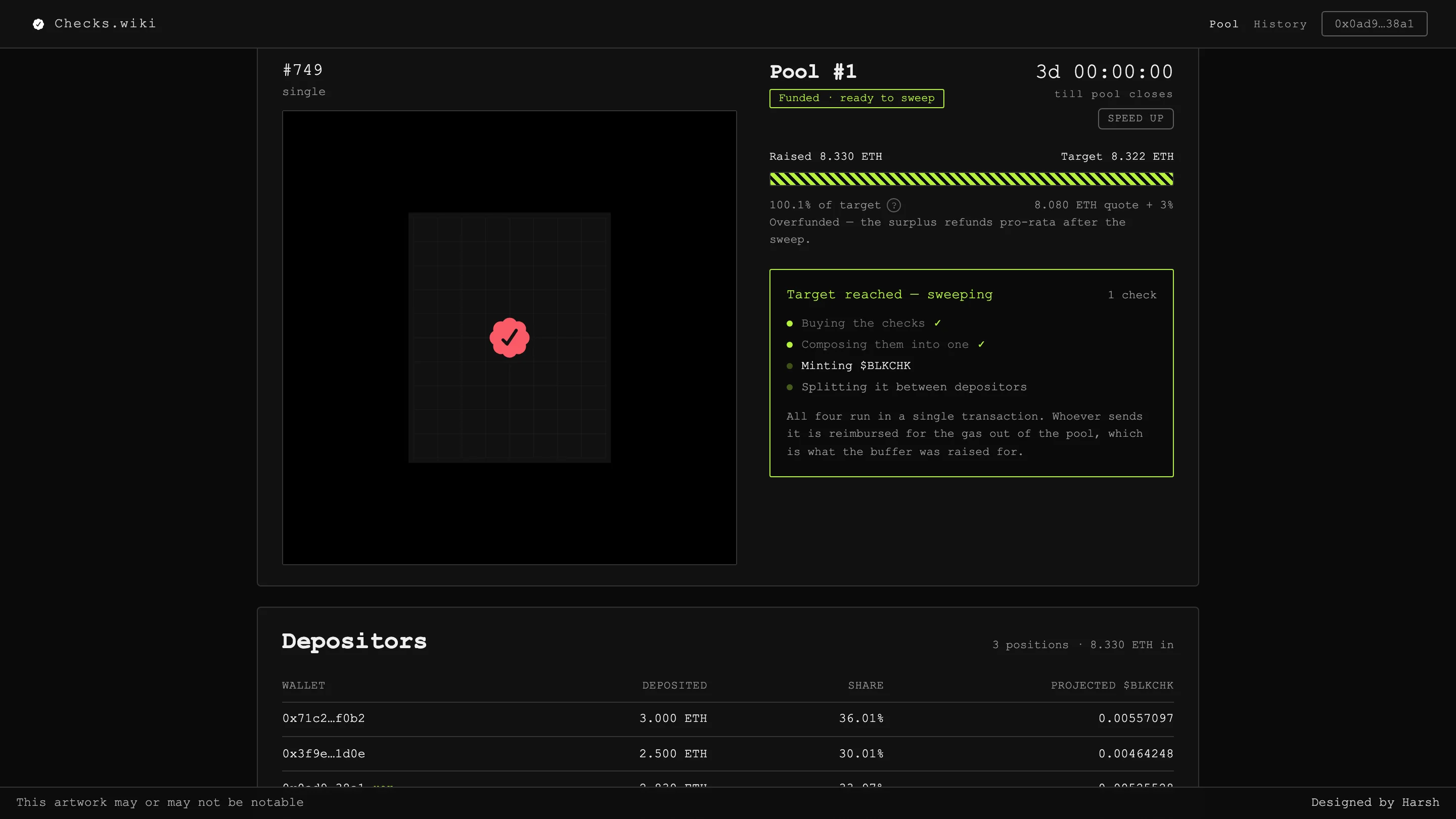
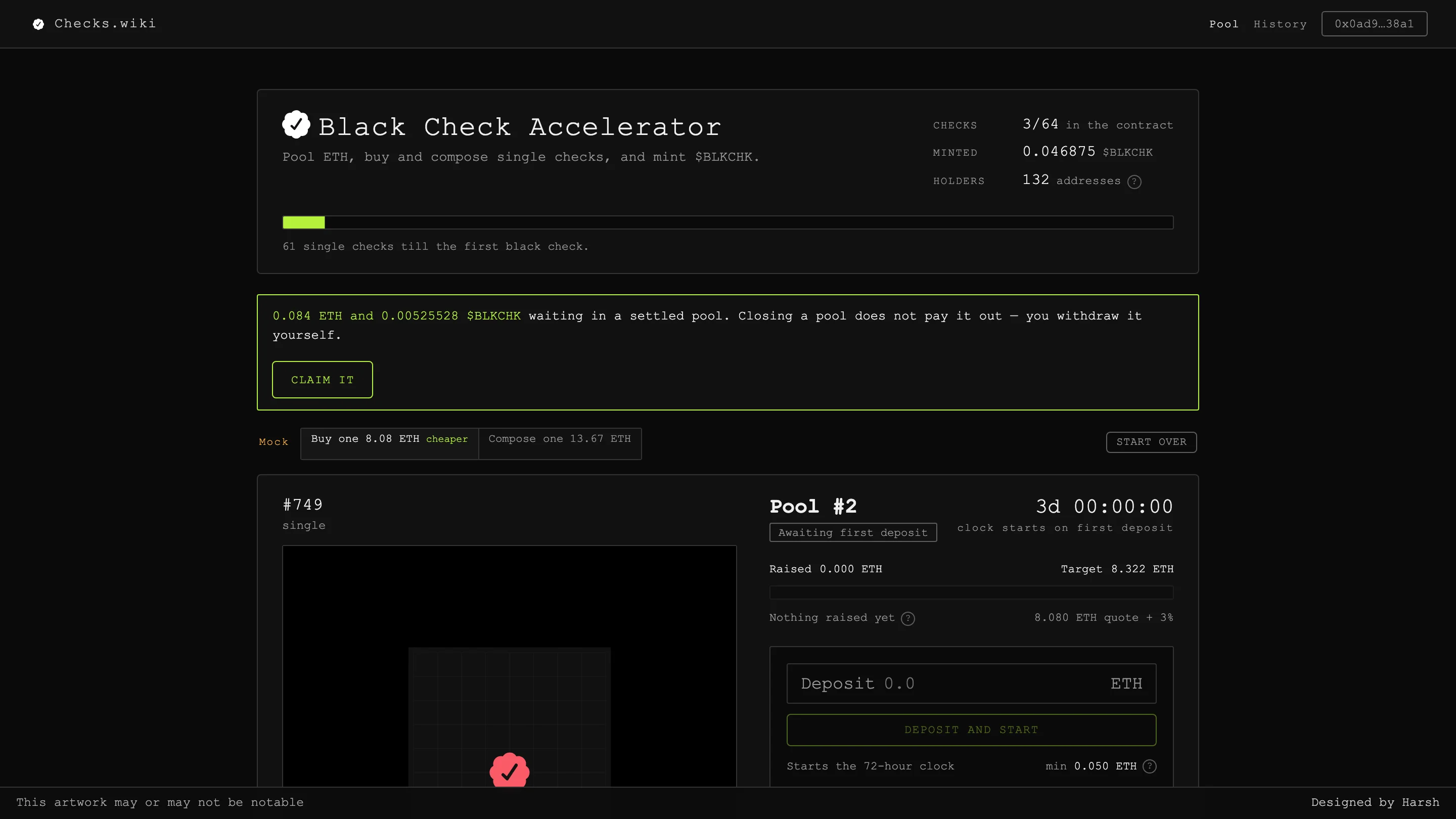
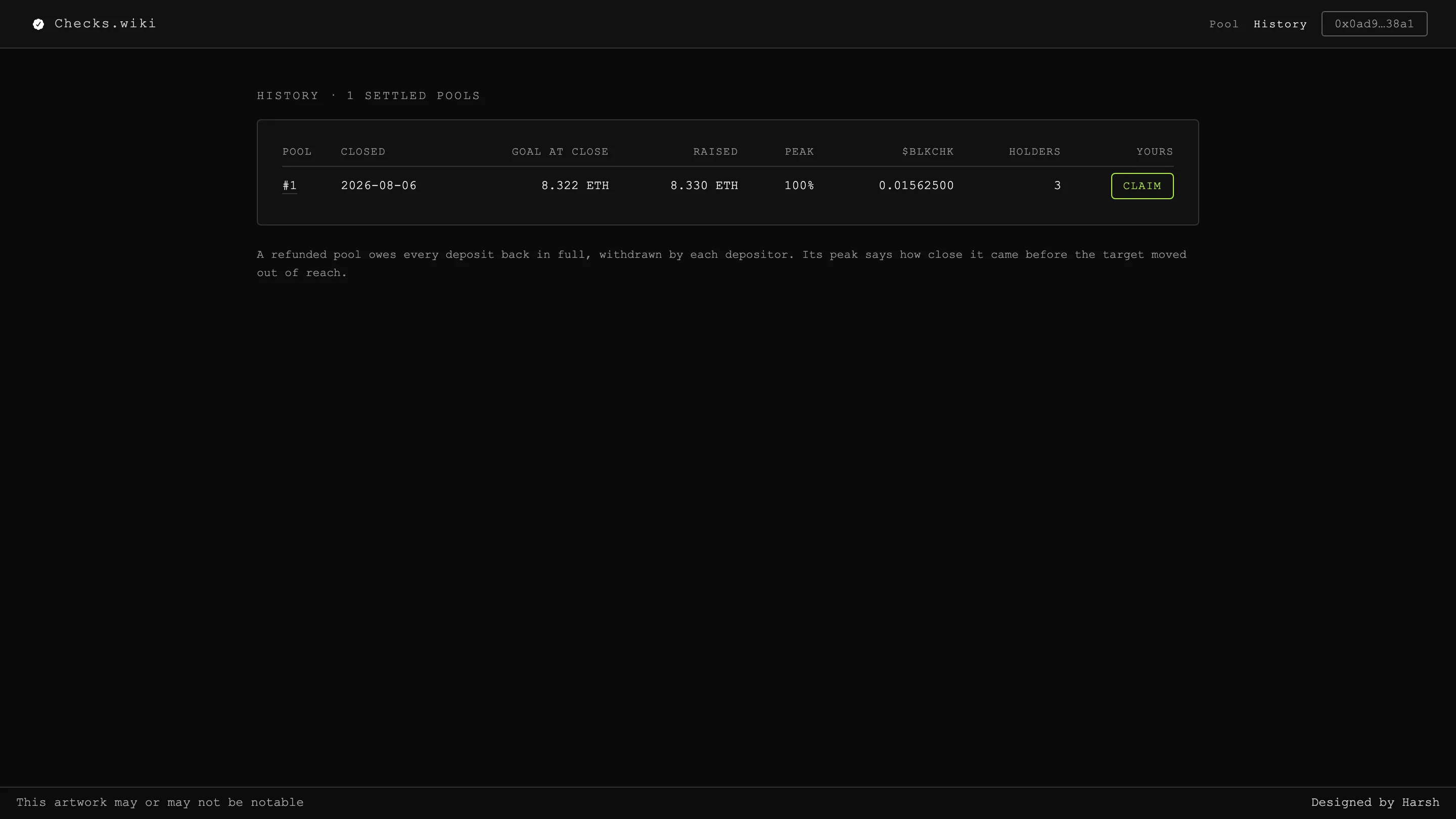
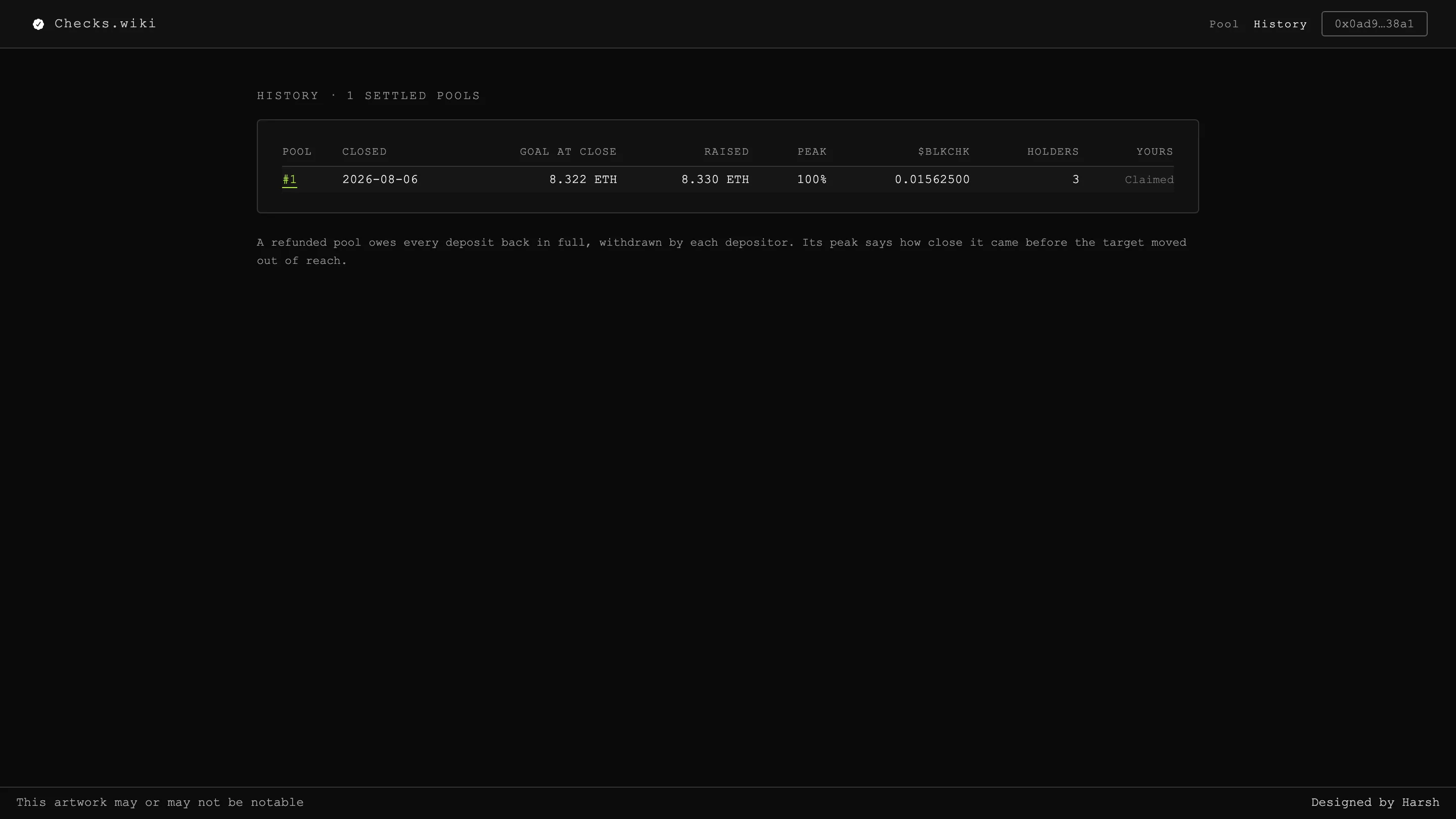
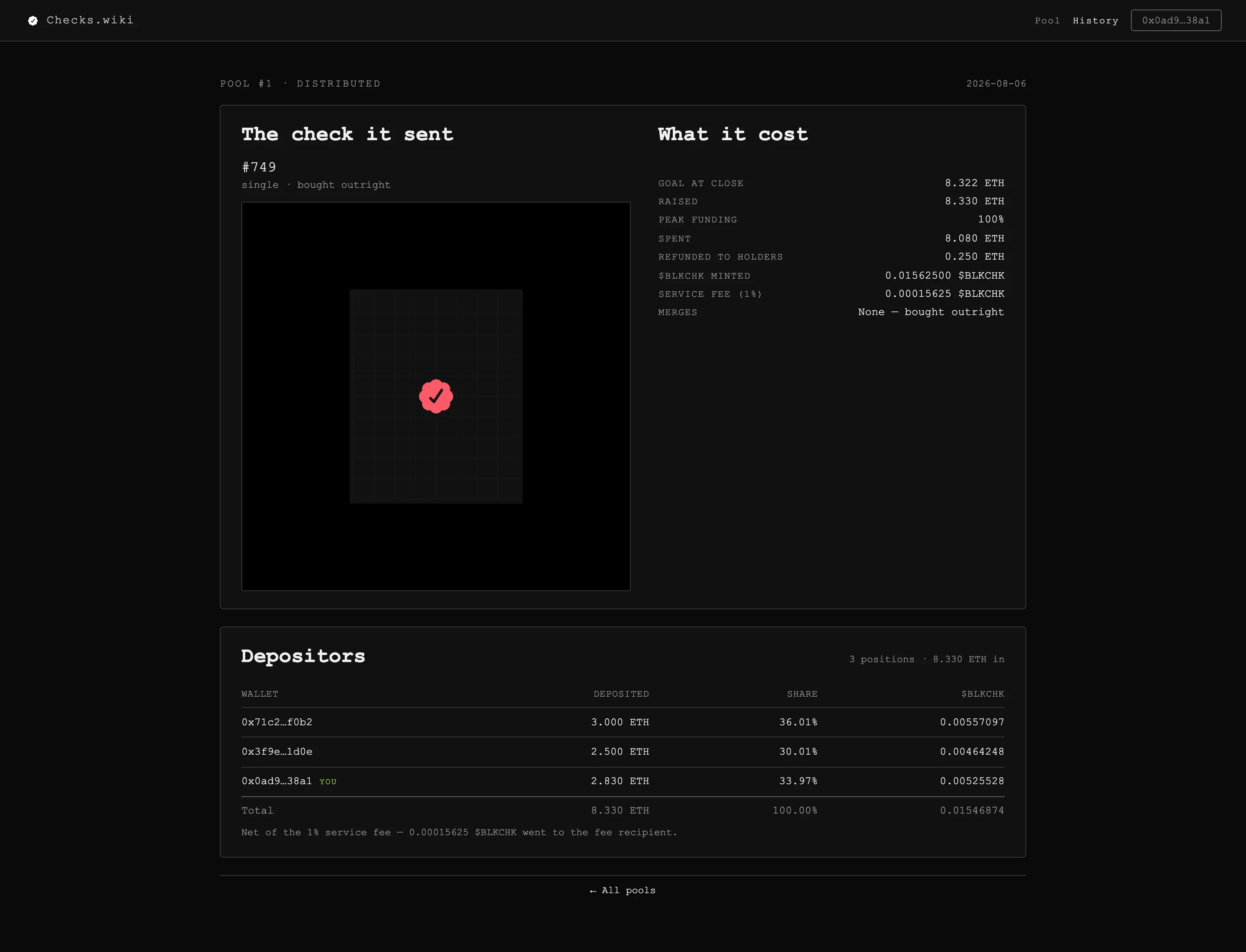
Collectors want a Black Check without giving up checks they curated, so blkchk.checks.wiki crowdsources the money. Anyone can join a pool. When it fills, it buys or composes one single check, puts it into the Black Check contract, and pays depositors in $BLKCHK by share.
No pool has filled yet, so the playback above is a rehearsal in the app's own mock: the same interface and the live market's plan, with made-up wallets. The question the page is built around, and the one I'm watching, is what a collector does once they see the exact check a pool will produce: deposit, or leave.
How the pool works
Anyone can join from 0.05 ETH. When the pool fills, it takes the cheaper route to one single check: buying one outright, or sweeping the checks no one wants to buy and merging them. Depositors receive $BLKCHK, split by share, less a 1% fee. If a pool doesn't fill in 72 hours, everyone is refunded.
The page can show the exact check because the order of the merges is fixed. Whatever the pool buys is merged tier by tier, lowest token id kept, so the result follows from the basket and nobody chooses it. The same reasoning is why the contract has no owner and no upgrade path: the rules a depositor reads are the rules their money is held under.
- Chose
- One fixed merge order, so the page can show the exact check a pool will produce
- Instead of
- Letting depositors vote on the outcome
- Because
- A vote needed bookkeeping and could land on a check the pool couldn't make. A fixed order needs no trust, in me or in other depositors.
- A 72-hour clock. It starts on the first deposit. Miss the target and everyone is refunded.
- Where the target comes from. The live quote plus 3%, shown beside it.
- The minimum. 0.05 ETH to join.
- The exact check. #749, the single check this pool will produce.
07 · Result
Three tools shipped. More to build.
What shipped is a workbench for an action that can't be undone: price the two routes, see the merge before the burn, and pool toward a Black Check without anyone giving up a check they curated. All three tools are live, with three contracts on Ethereum behind them.
An earlier pool on the accelerator drew deposits from 2 wallets, did not fill in its 72 hours, and refunded both. That is the rule working. Usage hasn't matched the attention the launch got. I think that is mostly the NFT market, which is at a low. The project isn't finished: I plan to keep building on it, to give more collectors a reason to use it.
I shared the tools with the Checks team for feedback and iterated on them before shipping publicly. On launch day Jack Butcher, the artist behind Checks, quoted the launch post.
Showing the outcome before an irreversible step is a rule I first wrote on ValyouX, where every payment screen said what would happen to the money before the button. Here the irreversible thing is a burn, not a payment.
- Views
- 14,387
- Likes
- 67
- Reposts
- 3
- Replies
- 4
 Jack Butcher@jackbutcher · Aug 14, 2026excellent checks tools by @0xHarshethHarsh@0xHarshethMerging checks is irreversible. You burn one token to find out what the other becomes. What if you can see it first — every composite four checks can make, rendered before you spend anything.